
The Need for Strategic Integrative Leaders in Movement Ecosystems
“The whole body, joined and held together by every supporting ligament, grows and builds itself up in love, as each part does its work.” — Ephesians 4:16
Over the last decade of working alongside rural disciple-making and church-planting organizations, I have become increasingly convinced that sustainable movements are not built by focusing on a single ministry activity.
Many organizations understandably focus on measurable outcomes such as salvations, baptisms, church attendance, new church starts, or leadership training. These are important indicators and worthy of celebration. Yet experience suggests that long-term fruitfulness depends on something deeper.
Healthy movements emerge when multiple parts of the ecosystem grow together.
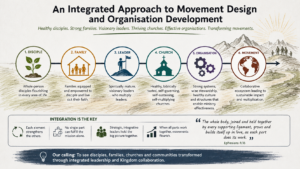
Looking Beyond the Church and its statistics
When we think about movements, we often think primarily about churches. But churches do not exist in isolation. Churches are led by people. People belong to families. Families are shaped by values, relationships, and culture. Churches are supported by organizations. Organizations provide leadership, systems, resources, accountability, and strategic direction.
Movements emerge when all of these elements work together toward a common mission.
This has led me to think about ministry through six interconnected dimensions:
Disciple → Family → Leader → Church → Organization → Movement
Each layer influences the next.
Healthy Disciples
Every movement begins with disciples.
The question is not simply how many disciples are produced, but what kind of disciples are being formed. If someone participates in a church community for three years, are they becoming more like Christ? Are they growing spiritually, emotionally, mentally, relationally, and practically? Are they flourishing in their marriage, parenting, work, friendships, and community life?
Jesus did not call us merely to make converts but to make disciples who obey everything He commanded (Matthew 28:19-20).
Healthy movements require healthy disciples.
Healthy Families
Families are often the most overlooked environment for discipleship. Scripture consistently places spiritual formation within the context of everyday family life.
“These commandments that I give you today are to be on your hearts. Impress them on your children.” (Deuteronomy 6:6-7)
Families possess resources that no program can fully replace—time, relationships, influence, culture, and example. Churches can support discipleship, but they cannot replace the discipleship responsibility of the home.
Healthy movements strengthen families and equip them to become places where faith is lived, practiced, and passed on.
Healthy Leaders
Healthy disciples and families create the conditions for healthy leadership. Leadership is one of the most significant multipliers in any movement. The Apostle Paul invested deeply in leaders such as Timothy and Titus because he understood that movements advance through people who can faithfully steward responsibility and influence.
“Entrust to reliable people who will also be qualified to teach others.” (2 Timothy 2:2)
Healthy leaders demonstrate spiritual maturity, emotional health, integrity, wisdom, humility, and the ability to develop others. Most importantly, they can see beyond their immediate ministry responsibilities and understand how different parts of the ecosystem fit together.
Healthy Churches
The local church remains God’s primary instrument for nurturing believers, developing leaders, and engaging communities. Healthy churches teach sound doctrine, cultivate discipleship, identify gifts, provide pastoral care, and participate in God’s mission.
In many church-planting movements, the aspiration is to see churches become:
- Self-governing
- Self-sustaining
- Self-multiplying
Such churches are capable of stewarding local leadership and resources while continuing to participate in Kingdom expansion.
Healthy churches provide the environment where disciples, families, and leaders can flourish.
Healthy Organizations
Behind every sustainable movement are organizations that provide structure, stewardship, accountability, and support. Organizations create the systems that enable ministry to happen consistently and effectively. Vision, leadership development, financial stewardship, supervision, culture, communication, and accountability all contribute to long-term effectiveness.
Organization is not the enemy of movement.
Rather, healthy organizations create the conditions in which movements can flourish beyond a single leader or generation.
Healthy Movements
When disciples, families, leaders, churches, and organizations work together, movements emerge. Movements are strengthened through collaboration between churches, ministries, and organizations that bring complementary strengths. No single church or organization possesses every gift or resource needed for community transformation.
Partnership and collaboration accelerate learning, innovation, and multiplication.
The Missing Leadership Challenge
One observation has become increasingly clear:
Integration rarely happens by accident. Many leaders are excellent practitioners. Some excel in discipleship. Others excel in church planting. Others are gifted administrators or visionary pioneers. Yet sustainable movements require something more.
They require leaders who can see the whole ecosystem.
Leaders who understand how disciples influence families, how families influence leaders, how leaders shape churches, how churches interact with organizations, and how organizations contribute to movement growth. These leaders think beyond individual programs and activities.
- They think systemically.
- They think strategically.
- They think generationally.
At the church level, they help develop disciples, strengthen families, and identify future leaders. At the organizational level, they build structures, systems, cultures, partnerships, and leadership pipelines that support long-term sustainability. They serve as integrators.
They ensure that no single area grows at the expense of another.
The Need of the Hour
Perhaps one of the greatest needs facing movements today is not simply more resources, more training, or even more workers.
It is the development of strategic integrative leaders. Leaders who can hold both the microscope and the telescope. The microscope helps them care for individual disciples, families, and churches. The telescope helps them see the larger movement ecosystem and steward it wisely for future generations.
As movements continue to grow around the world, the challenge is no longer simply multiplication.
The challenge is sustainable multiplication.
- Healthy disciples.
- Healthy families.
- Healthy leaders.
- Healthy churches.
- Healthy organizations.
- Healthy movements.
When these dimensions work together, movements become resilient, fruitful, and capable of lasting Kingdom impact.
“Unless the Lord builds the house, the builders labor in vain.” — Psalm 127:1
Director of Partner Relationships, Global Assist